Thermal Imagers
Thermal imagers (TI) use passive infrared sensors to detect IR radiation given off by warm objects which is then translated into a visible picture for the device's operator. Particularly effective at night when ambient heat is less, a good thermal imager can show up the heat given off from people, vehicles and enemy positions. Thermal imagers are a superb tool for battlefield reconnaissance.
Thermal Imaging Gun Sights
FIST Thermal Sight (FTS)
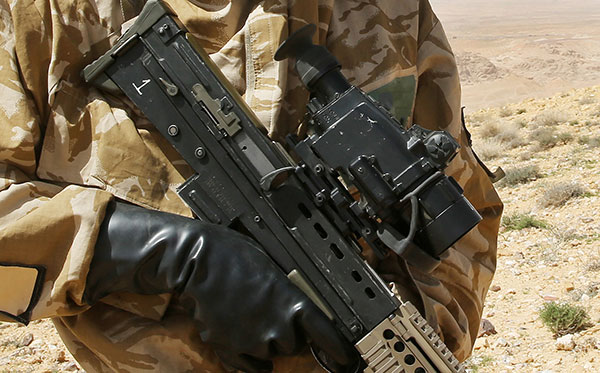
The FIST Thermal Sight (FTS) is an uncooled thermal imaging scope designed to be mounted on rifles and light machine guns. It was brought into service as part of the Surveillance and Target Acquisition (STA) element of the MoD's Future Integrated Soldier Technology (FIST) program.
Qioptiq Ltd, make the FTS, who also call it the Dragon SR. According to the product brochure, the Dragon SR can detect a man out to distance greater than 2km. The FIST comes with closequarter battlesight (CQB) red dot scope mounted atop the scope.
Used under Open Government Licence
The FTS is carried by reconnaissance units such as the Special Reconnaissance Regiment and Brigade Reconnaissance Forces. The device can be mounted on the top rail of a L119A1/A2 carbine, L85A2/A3, LMG or employed as a hand-held scanner.
Related link
- Photo of members of the Pathfinder Platoon toting L119A1 with mounted FST
(http://tank-masters.de)
FIST Thermal Sight Specs
- Field of View: 8° HFOV
- Magnification: x3, x6 (electronic zoom)
- Range: Detection of man >2000m
- Weight: <730g (excluding accessories and batteries)
- Detector type: 8-12 μm, 320 x 240 pixel @25μm pitch FPA
- Batteries: 4 AA batteries
- Battery Life: >8 hours at 23°C continuous operation (Lithium)
- Features: Video out, RS232 comms
- Accessories: Weapon bracket, lens cap, eyeguard, pouch, transit case, cleaning cloth, instruction card, tripod mount and interface cables
- Optional extras: Red dot CQB sight, Laser pointer, Remote control
Sniper Thermal Imaging Capability (STIC)
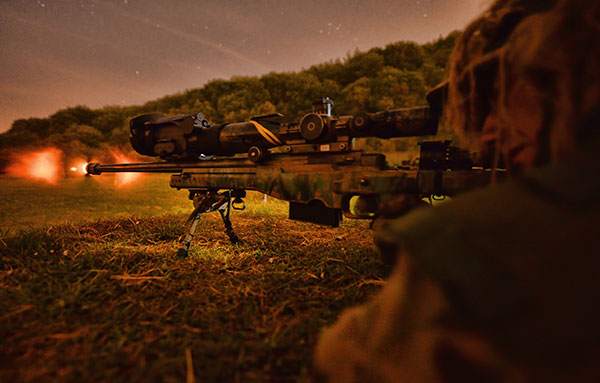
The Sniper Thermal Imaging Capability (STIC) is an in-line, or 'clip on', thermal imaging sight that is mounted forward of a sniper rifle's main dayscope. The STIC is the result of a 2009 urgent operational requirement (UOR) to enable British snipers in Afghanistan to engage targets in extreme low light conditions, where their image intensifier night sights were ineffective. The STIC can be mounted on the L115A3 sniper rifle and the L121A1 Anti-Material Rifle.
Used under Open Government Licence
Qioptiq Ltd makes the STIC, who sell it as the SVIPIR-2+ Thermal Weapon Sight. The sight can detect human targets up to 1.5km out. It features a video-out facility and can be used as a hand-held surveillance device.
STIC Specs
- Field of View: 6.75° HFOV
- Magnification: x1.0
- Range: Detection of man at 1500m **
- Weight: 1600g (excluding bracket and batteries)
- Detector type: 8-12 μm, 320 x 240 pixel uncooled microbolometer
- Batteries: 4 AA batteries
- Battery Life: > 6 hours at 20°C continuous operation (Lithium)
- Features: Video out
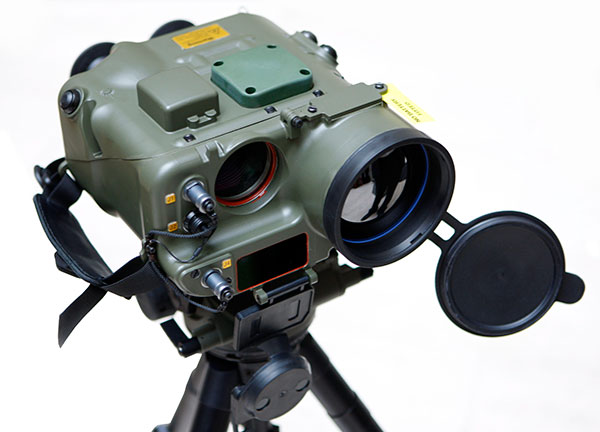
Thermal imagers can be dedicated units or part of target acquisition systems on weapons such as anti-tank missile launchers. Types in use in the UK military include :
- OBSERVER'S THERMAL IMAGING SYSTEM (OTIS)
a tripod-mounted TI with built-in laser range finder often used for fixing a target's position for air or artillery strike. The OTIS can spot targets up to 6kms away. - SPYGLASS
hand-held or tripod-mounted Thermal Imager with day/night capability and an acquisition range of 2.5km. - JAVELIN MISSILE
the command launch unit (CLU) of this anti-tank missile contains a sophisticated thermal imaging sensor that can double as a reconnaissance tool. - MILAN MISSILE
the now obsolete Milan wire-guided anti-tank missile system featured a MIRA thermal imaging sight, with a range of 4km. - APACHE GUNSHIP TADS
the Target Acquisition Designation Sight (TADS) sensor suite in the nose of the WAH-64 Apache helicopter, whilst primarily designed to find enemy armour, can also sweep the ground for troops.
Used under Open Government Licence
Use of Thermal Imagers by UK Special Forces and Elite Troops
UK Special Forces first reported use of a thermal imager in a conflict was during the Falklands campaign in 1982. On the night before the main British landings, the Special Boat Service (SBS) used a spyglass thermal imager to locate an Argentine force atop Fanning Head. When combined teams of SBS and 148 Bty Naval Gunfire Specialists inserted by boat onto West Falklands, they used a TI to scan the shoreline for Argentine troops.
Working deep behind Iraqi lines during Desert Storm, SAS Landrover columns used the MIRA sights from their MILAN launchers to scout the desert for enemy forces.
In more recent actions, 45 Commando, Royal Marines are known to have used tripod-mounted TIs during Operation Ptarmigan, their hunt for Taliban and Al-Qaeda fighters in high mountain valleys of Afghanistan.
When 3 PARA deployed to Helmand Province, Afghanistan, in 2006, they found that the TI sights of the new Javelin missile to be an a invaluable aid for spotting Taliban forces hiding out in the darkness.
Thermal imagers also have a role in counter terrorism operations. In some circumstances, TIs can be used to locate people through the walls of a building, helping the SAS to build up a picture of what's happening inside.