Mobility Troop
Experts in the use of vehicles and heavy support weapons, the men of mobility troop provide the SAS with the ability to move around the battlefield and pack a big punch, independently of other forces.
Since their inception in the deserts of Northern Africa during World War 2, the Special Air Service has employed vehicles. Fixing multiple machine guns to jeeps, the SAS would drive onto German airfields, shoot up the parked planes and ammo stores, then retreat into the desert. Mobility troop ensures that the skills required for such operations stay intact within the squadrons.
Those members of the SAS who are assigned to Mobility Troop become masters of the various required disciplines, including :
- Basic mobility
Getting heavily laden vehicles over all kinds of terrain. - Maintaining and repairing the vehicles.
When operating often deep behind enemy lines calling the RAC is not permitted! Mobility troop members go on extensive REME (Royal Electric Mechanical Engineers) training courses to gain their skills at maintaining vehicles. - Navigation
SAS mobile operations often take place often over featureless terrain. Modern day SAS troopers have access to electronic navigation aids such as GPS (Global Positioning System) but must be able to fall back on more basic skills such as map reading and navigating by the stars. - Logistics
Long missions behind enemy lines and away from re-supply require strict rationing of fuel, ammo and other stores. Everything needed for a mission has to be carefully loaded onto the vehicles before leaving. - Use of heavy support weapons.
An SAS fighting column of 8 vehicles can, when used correctly, attack with the firepower and effect of a much larger unit. Heavy weapons such as mortars, anti-tank missiles, heavy machine guns and grenade launchers can be brought to bear on the enemy whilst other elements push forward. These heavy weapons can be fired from the vehicles or dismounted and used on foot.
Vehicles
Some of the vehicles in Mobility Troop's inventory include:Land Rover 110 Desert Patrol Vehicle
A special version of the standard army Land Rover, SAS 110s, or 'pinkies', are usually festooned with machine guns and other weapons.
more info: SAS Land Rovers
update : the SAS Land Rover 110 is being phased out in favour of a new vehicle
Supacat HMT 400
It is now understood that for the last few years, SAS Mobility Troops have been using the Supacat HMT 400 as their primary reconnaissance / attack vehicle.
more info: Supacat HMT 400
Bushmaster IMV
Recent press reports indicate that the SAS are using this armoured vehicle in Iraq.
more info: Bushmaster IMV
Light Strike Vehicle (LSV)
Military dune buggies used for rapid assault operations
more info: Light Strike Vehicle
Unimog U1100 / ACMAT VLRA
A cut-down army truck, the Unimog U1100 or Acmat VLRA acts as a mothership, carrying extra fuel, water and ammunition for the other vehicles in a mobile SAS force. These support trucks will typically be armed with GPMGs, M2s or Mk19s/GMGs for defensive purposes, but would not usually be used in offensive operations. For greater protection, these support vehicles will tend to travel in the middle of SAS columns.
Unimogs accompanied Landrover Defender 110 Landrovers during SAS operations during Operation Desert Storm, 1991. Reports on SAS ops in Afghanistan, 2001, including the 2-Squadron mission, Operation Trent, suggest that 22 SAS now prefers the Acmat VLRA for the support role.
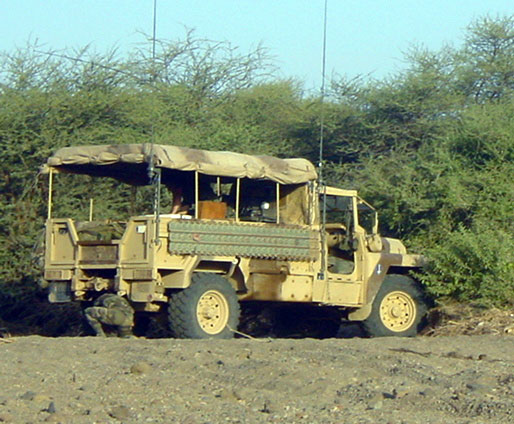 It is belived that during the 90s, the SAS purchased up to 24 ACMAT VLRA trucks for its mobility troops, largely replacing the Unimogs. (picture shows a French Foregien Legion VLRA in Djibouti.)
Motorcycles
SAS Land Rover columns are accompanied by several motorcycle outriders. SAS motorcyclists scout ahead and around the main column, searching for the enemy and finding routes. In covert environments where radios aren't used, the outriders pass information between the wagons.
Snow Vehicles
Mobility troop operate several vehicles designed for arctic conditions including snow mobiles and tracked vehicles such as the Hagglunds BV 206D. The SAS Sabre Squadrons would regularly practice in Norway as part of their NATO commitment was protecting Europe's Northern Flank against a Soviet advance.
« special air service