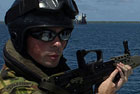
Special Air Service (Reserve) - (SAS(R))
The 2 territorial SAS regiments, 21 and 23 SAS, who form Special Air Service Reserves (SAS(R)), are independent entities staffed by civilian volunteers (except for senior ranks who are from 22 SAS).
SAS(R) comprises:
- 21st Special Air Service Regiment
(21 SAS(R)) - HQ Squadron based at the Duke Of York Barracks in London
- A Squadron (Greater London)
- C Squadron (East Anglia and Eastern Wessex)
- E Squadron (Wales)
- 23rd Special Air Service Regiment
(23 SAS(R)) - HQ Squadron (West Midlands)
- B Squadron (Yorkshire and Humberside)
- D Squadron (Scotland)
- G Squadron (North and North West of England)
21 and 23 SAS reservists are given communications and signals intelligence (SIGINT) support by 63 (SAS) Signals Squadron, of the Royal Corps of Signals, also manned by volunteers.
As of September 2014, 21 and 23 SAS fall under the command of the newly established 1st Intelligence Surveillance and Reconnaissance Brigade.
SAS(R) Role And Operational History
The current role of SAS(R) is to carry out Human Environment Reconnaissance and Analysis (HERA) operations. This is a new role assigned to them following their move from UKSF to the 1st Intelligence Surveillance and Reconnaissance Brigade.
The traditional role of 21 and 23 SAS was to carry out long range reconnaissance patrols for the regular UK Army
In the 1991 Gulf War, members of SAS(R) were used as battlefield casualty replacements for deployed 22 SAS units, namely landrover fighting columns from A and D Squadrons who were operating in the Iraqi Desert.
SAS Reservists deployed to the Balkans in the mid-90s. Members from 21 and 23 SAS formed a composite unit known as 'V Squadron' and were engaged in peace support operations.
In 2003, it was reported that 21 and 23 SAS had been operating in Afghanistan where they have carried out long range reconnaissance operations(1).
Another role that SAS reservists are thought to carry out is that of so-called 'hearts and minds' operations. On such missions the SAS give medical and other assistance to local forces and populations in a given theatre. In Helmand Province, Afghansitan, SAS(R) were reportdely deployed in a mentoring role, training and operating alongisde the Afghan National Police (ANP).
According to a April 2010 Telegraph report(2), SAS(R) first deployed to Afghansitan in 2003 where they helped to establish a communications network across the country. They also acted as liason between various local political factions, NATO and the new Afghan goverment. The same report mentions that SAS(R) were withdrawn from frontline duties in Afghanistan due to a lack of a clear role. Their mentoring role with the ANP was taken over by regular units. Some SAS Reservists were reported to be carrying out close protection duties for Foreign Office personnel in Kabul, Afghanistan's capital city.
The men of 21 and 23 SAS are typically issued with standard UK infantry weapons, ie the SA80, LMG, GPMG etc.
SAS (R) Selection
Selection is open to men over 18 and under 32 (or under 35 for those with military experience) who are fit and do not have a criminal record. Selection itself consists of a series of physical tests run over a series of weeknights and weekends, in keeping with the part-time nature of TA units.
Selection consists of the following phases:
1. APTITUDE
Physical and mental stamina, along with navigational ability are stretched to the limit over series of tests. The aptitude phase culminates with a 64 kilometer march, with a 60lbs bergen, over the Brecon Beacons in Wales. Aptitude consists of:
2. STANDARD OPERATIONAL PROCEDURE (SOP) TRAINING
- 9 x weekends of endurance training.
- 1 x week endurance training in the Brecon Beacons.
- 1 x week assessment (Test Week) in the Beacons.
Instruction in UKSF SOP'S and tactics comprises of:
- 9 x weekends patrol SOP's including surveillance and reconnaissance.
- 1 x week live firing including patrol contact drills and Tp offensive action.
- 1 x 9 day battle camp comprising:
- Live firing assessment.
- Field training exercise to test the skills learned throughout Selection. This culminates in Conduct after Capture (CAC).
On successful completion of this training, ranks are badged as SAS(R) and are assigned to their respective units for continuation training.
SAS(R) CONTINUATION TRAINING
Candidates who successfully complete Selection will enter a period of probation and must complete the following courses to be fit for mobilisation.
- Basic Parachute Course.
- SF Communications Course.
- Main Training Period.
Once successfully through continuation training, SAS(R) soldiers will undergo periodic UKSF Military Annual training Tests (MATTs) and Main Training Periods. Additional qualifications can be sought throughout the SAS(R) soldier's career:
- Patrol Medics
- Enhanced Surveillance and Reconnaissance
- Languages
- Emergency Close Air Support
- Support Weapons
- Close Protection
A further reserves element exists, called L Detachment. Unlike 21 and 23, who are independant entities, L Detachment is directly attached to 22 SAS